Tuesday, 9 June 2009

Unit 21: Single-Camera Techniques


Task 1 (P1,M1,D1)
Single and Multi camera techniques


The single camera technique involves using one camera on the set of the show or film, using this one camera, all of the footage on that set is filmed. This doesn’t mean that all of the film or programme is filmed with one camera; it just means that only one camera is being used to film the scenes.


The multi camera technique is very different. This is where two or more cameras are used simultaneously however using different angles. By doing this, when the footage is edited, editors can switch between shots. The multi camera technique is also used regularly on live footage, when someone gives orders to switch between cameras.


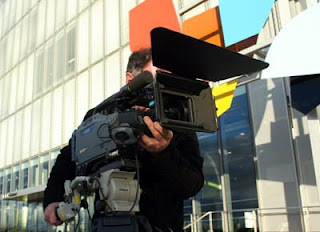
There are various different advantages with filming footage using the single camera technique. First of all, using the one camera is often cheaper than using 2 or more, and especially in today’s current financial climate, the cheaper option could be much more beneficial. As well as this, filming on location is a lot easier due to a lot less equipment being
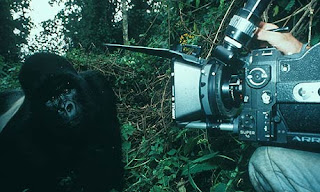
needed to power the fewer number of cameras and if the majority of the film is set on location, then the single camera will obviously be more advantageous. A scene involving two people and dialog could be filmed with one camera meaning that not both actors have to be on the set at the same time, the camera can film one persons dialogue and then another’s at a different time. This means that more than one scene can be filmed at the same time on different sets decreasing the time it will take to finish the product. Plus with a single camera you can have
a lot more involved camera shots where the camera could be used say for a tracking shot, and by using more involved shots the camera acts as part of the set and allows the viewer to feel much more like an element to the film or programme.


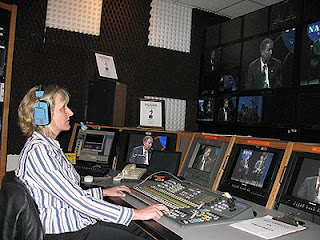
The benefits of using multi camera techniques are quite different. Although single cameras could arguably decrease the time it takes to film on different sets, the multi cameras would shorten the time it takes to film one scene and considering the use of the actors, we would be able to witness their reactions immediately adding to the realism of the product. If footage is live however using a multi camera is extremely advantageous because as well as being able to film the main purpose,


another camera could be used for extreme close ups acquiring peoples reactions, and by switching between the main object and reaction shots like a montage, the pace of the piece can be quickened and the effect of the product could be more intense. This is a highly beneficial factor if many of the audiences start to become uninterested in watching a debate or two people have a conversation. Finally using the multi camera technique there is no real limit to the number of shots, angle and effects you can use, and by having a variety of different shots to work from editors can increase the opportunity of creating a certain desired effect on the audience.


Examples of single camera dramas can be found by following this link to Wikipedia:http://en.wikipedia.org/wiki/List_of_single-camera_sitcoms


Task 2

(P1,M1,D1)
NARRATIVES
http://www.slideshare.net/jontowlson/tv-drama-formats
There are a variety of different single camera programs which are all broadcasted regularly, for example first of all there are
series. Series are programs which usually run for the length of around 5 to 25 episodes long. Series are extremely popular and due to their popularity more and more series of a certain programs are made. A lot of this popularity comes down to the different series being aimed a different audiences, for example Doctor who is an extremely popular single camera sci-fi series aimed mainly at a younger audience and fans of that genre. Other series such as 24
and lost, two of the most popular television series in America are both aimed at a much older audience due to it’s much more realist narrative.


The next example of single camera programs are
serial programs. Serial programs are programs which usually portray books or screen plays written by authors. Serial programs usually run for 2 or 3 episodes which usually run for 2 or 3 episode and are most commonly recognised as period dramas such as Jane Austin’s sense and sensibility or more recently ITV’s Withering Heights by Emily Bronte which run for the duration of 2 episodes over two following days.

Another form of program which can use the single camera technique is a single drama. A single drama is very different to the other examples because of the fact that the program starts and finish within the same episode. They are becoming a lot rarer on television today however usually attract a lot of attention when advertised and promoted, recent examples of single dramas are BBC 2’s White girl, and also Channel 4’s The shooting of Thomas Hurndall. However much older examples can be found on the following link: http://www.bfi.org.uk/features/tv/100/biglist/drama_single.html


The next example of program are docu dramas. These are becoming increasingly popular on television, they are based upon non fictional events which happen to a single person or based upon a non fictional experience. The program consist of a reconstruction of the event with the persons voice describing the event juxtaposed over the top of the reconstruction. These are commonly shown on programs such as Watchdog and Crimewatch and also on programs which reconstruct events where people make miraculous escapes or survivals.


Finally there is also the category of a single camera film. These are a lot less common than multi camera films and are usually created for a very specific effects. The director Quentin Taren Tino uses the single camera technique in his films , examples of his work using this technique are films such as Kill Bill and Pulp Fiction, and because of him using this technique he has become world famous for a highly unique and effective style of film. Another example of a single camera film is the movie Blade Runner starring Harrison Ford which has a very film noir feel.

TASK 3
All of these programs can have a verity of different narratives which all have different effects and are relative to the programs characters. One form of narrative is the
linear or sequential narratives. This is when a narrative runs in sequence; this is one of the most common forms of narrative. Soap operas use this narrative due to the fact that it runs in the exact same way as our life, and as you will see when watching Corronation Street and Eastenders very are hardly any flashbacks or changes in time.


Non linear narratives are the complete opposite to that of the first one, instead or the storyline running in an order, the narrative has no specific order. Instead they can go from the middle to the start to the end of the event or sometimes the end to the beginning to the middle, A lot of programs like this usually have characters thinking back to certain times perhaps before a disruption took place, or in some programs such as doctor who where actual time travelling takes place. Sky’s Lost is a good example of this form of narrative, not only for the fact that the island is travelling through time, but also because of the fact we are witnessing the happenings of the story through the eyes of different characters.

Flashbacks is a very good form of narrative where usually the audience is presented with an enigma or a disruption which immediately leaves them anchored into the program, which is a hugely desired effect by directors and producers who by using this technique can make the audience keep coming back for more and more. The only way that the story the storyline and twist can be revealed is by playing flashbacks up to the actual equilibrium, this creates a lot of suspense which is a massive advantage in keeping the audience engrossed in the programs. Lost is also a good example of this too because the program uses a lot of flash backs or characters past so that twists and actions can be explained and slowly unveiled.

Amongst these narratives the program can also be realist or anti realist. This usually depends upon the programs genre, for example Doctor who is of the sci fi genre and features spaceships, aliens and time travelling, it is also highly anti-realist due to the fact that the narrative is not based on realistic events. On the other hand there are programs such as 24 which are based on realistic events tackling the issues of terrorism and conflicts etc.

Endings also play a huge part in a programs narrative, they can make or break the success of a a programs. Extremely popular programs such as prison break ends with an open ending, this means that the story is not ended on that season; instead the audience is usually left with an enigma of some kind which forces the viewer to wait until the next season just so that this enigma will be explained or resolved. The opposite of this is where an ending is closed. A closed ending is simply where the program or storyline will finish on that exactly season or episode. So usually the ending of the very last series will be left closed because no more following series. Plus on programs such as the IT crowd, because the storyline is different in each episode and don’t follow on, at the end of each episode there is a closed ending.

A narrative also often contain patterns, for example a lot of narratives these days are based around goal orientated plot meaning that someone is taking action to succeed in something, so in the case of prison break season 1 the goal for the main character is to break his brother out of prison. Programmes such as CSI use narratives which feature a search or investigation of some kind usually being to find out who murdered a victim. Other programs are based upon a journey of some kind, whether that is a actual journey of some kind or a metaphorical journey. And finally there are naartives which feature the pattern of a climax, where throughout the story more and more is being built up towards this climax, where increasing amounts of tension is being added finally to be resolved in the cases of some program, however in other cases not to be resolved at all.

If a narrative is restricted, then we are just like the character in the programme, we are only aware of the characters actions, feelings and responses. This means that when there is a twist in the story, we are as surprised as the character due to the fact we didn’t see it coming because we only see the programme through the eyes of a particular character. However if a programme is unrestricted, we know exactly what is going on with all the characters, this means that when there is a twist, we’re not exactly surprised, but more the fact we’re waiting for some sort of climax. Also films or programmes based on historic events such as Titanic where although the characters are unaware, we know that the boat hits an iceberg and sinks. Also many adaptations of books into films are unrestricted to anyone who has read the book, for example The lord of the rings, anyone who has read the story knows how it ends so the directors and producers must build up lots of tension for the climax.


As always there is the Torodov’s theory of every narrative having equilibrium a disruption and an ending/resolution. However as the case has been proved many times before, the order to these may change, for example, in prison break season 2, the very first episode starts with a disruption where the characters are still on the run from the previous season. Some films and programmes also start with the ending/resolution, and then the rest of the programme is a flashback of how the events happened to lead up to this resolution.

There is also the theory of Propp There is always a hero, villain and damsel in distress. This is generally the case for any television programme, on soaps such as eastenders; there is a large number of heroes villains and damsel in distress’s which all play part to different story lines, in films such as Armageddon where Bruce Willis is the hero, The comet is the villain, and the earth is the damsel in distress. So as you can see any of these roles aren’t played by a human. Also sometimes one role can be played by the same character. An example of this is in the Bourne trilogy, where as well as being the hero, the character of Jason Bourne can also be seen as the damsel in distress, as the whole goal orientated plot is about the character trying to find out about his real identity therefore being the damsel in distress.

In a subjective narration, it’s usually more of a point of view programme, we see things in a bias way of one particular character which means a lot of the time we feel the characters emotions and assume that the characters actions are correct without giving the story that much thought. Where as in an objective narrative, we see things as a whole, which means we see events which lead characters to their actions and we gain a much wider knowledge of the events usually leading to a completely different attitude towards a character and their actions. There are also subjective sounds; this is where we can hear only what the character can hear, for example rain, cars, explosions etc. Whereas an objective sound are things such as background music or noises such as drums.

24 is part of the action genre set as a series running for 24 episodes, each of these episodes represents an hour of the day creating a linear narrative in which the main character of Jack Bauer, better recognised as the hero in Propps theory is presented with a villain resulting usually as some part of America being the damsel in distress. This is where the narrative turns to a goal orientated plot involving key elements of a search or in visitation in which he can find a way to resolve the disruption placing the recognised damsel in distress back to equilibrium. The series shows extreme elements of a realist narrative as much of it tackles issues of terrorism, however to anchor the program, the action is slightly glorified adding one or two elements of anti -realism. Finally the main story for each season usually has a closed ending with a state of equilibrium, however one or two key areas of the program are left open ended so that the audience will have a desire to watch the next series.

Doctor who is a series program set in the sci-fi genre which is an immediate signifier that the program is highly anti realist due to the number of aliens, spaceships and time travelling which takes place. As well as adding to the anti-realism, the programs hero of the doctor being able to time travel means that the program will be non-linear, and because the doctor faces a new narrative each episode usually involving a new damsel in distress, then the endings are closed on each episodes apart from one particular theme which is left open until the very last episode. Due to its popularity, Doctor who also have one or two serial programs played as one offs where usually within two episodes, the doctor is set a new equilibrium disruption and resolution.

Serial programs such as withering heights are quite different, although they are much more realist than many programs, it was actually a non linear narrative due to the change from the present to the past vice versa. The narrative featured a climax at the end in which the hero who had some elements of a villain took his own life. Because it followed the novel, there was no open ending and the equilibrium was presented to the viewer, however much of the story is about not only the character going on a journey to find his love, but also a journey to find himself.

Coronation Street is a highly multi-narrative program which presents the audience with a number of disruptions each episode, some of these are resolved, and others are left in an open ending for the next sequential based program. Due to this multi narrative feature, there will be a variety of heroes, villains and damsel in distress, the will also be various patterns of narratives, so one person may be on a journey, whereas a different person may be on an investigation or goal orientated plot and perhaps all of these could lead to one big climax. Because of the all the attributes, Coronation Street is highly realist because it has been created to reflect everyday life.
TASK 4

We are presented immediately with an establishing shot that then pans to the left where we see a single character within the location; there is then a jump cut to a long shot of two other characters walking from the car. This currently gives the video an enigmatic feel, as we are currently unaware of what’s happening. As the shots jump between the two, the sound is non-diagetic, both the audience and the characters can hear the wind, the train and the footsteps. Quickly after the panning to the left, there is an extreme facial close up of the woman where we can see the characters emotion just by looking at her eye, she appears troubled and upset, and this immediately asks the question if she is the damsel in distress. The video constantly uses jump cuts to add effect to the piece making add tension, distress and create an enigmatic effect. The video uses a flashback, which as well as giving us then enigma which leaves us asking who she actually is, however at the same time we also learn a bit about this character when we see the close-up of the drugs and the extreme close ups of the newspaper which involves the signifier words such as ‘DRUG’ and ‘KILLED’ and the way the character reacts by throwing the newspaper onto the floor connotes the fact that she may not actually be the damsel in distress, but possibly the villain. This flash back is also shown in black and white, to signify the fact that all those events were past events which have possibly lead the the seen in the train station where apart from the light from the outside, the room is quite gloomy. I also feel that the echo from the room, especially from the woman footsteps which firstly connotes she is a very powerful woman, but secondly adds serious tension to the product keeping the audience anchored in to watching and trying to uncover the enigmatic narrative.

TASK 5
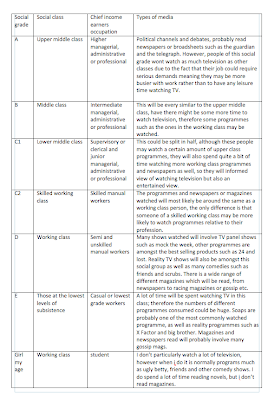
In the older days, every family had a television; this television would consist of the basic channels. BBC 1, BBC 2, ITV etc. Because of the few number of channels, advertisers had an extremely easy job, all the needed to do was place their advertisement amongst one of the channels and they were almost guaranteed a mass audience to view their product. However times have changed, technology has expanded, and the world of media has transformed. As the digital age has now taken over the world of television, there are now thousands of different channels which all have different niche audiences, This has created vast amounts of problems for advertisers as they can no longer acquire a mass audience due to the sheer fact that because of the choice in what to watch and when to watch a programme, all of what may have been a mass audience in the days of analogue at the peak of television choice are now scattered in all sorts of various channels. As well as this factor, there are now quicker and efficient ways to watch your favourite programmes, for example on BT Vision, viewers can simply select a series and watch all the episodes without having to put up with any sort of advertisements, this is also similar to the advantageous internet. There are loads of websites both legal and illegal where people can watch their favourite programmes for free, no breaks no advertisements. This has created a major problem for advertisers, some mange by finding their niche audience and promoting their goods as much as they can on these specialist channels, however other advertisers just can’t manage to gain a mass big enough to have a successful promotion.
TASK 6


TASK 7
To produce this short film, we will be using the following equipment:

The camera we will be using is the Canon MD205 Mini DV camcorder. Some of its features include: A canon 36x advanced zoom, A true wide high resolution and DIGIC DV for true to life colours. It is an ideal camera to use, as it will be more efficient when taking on location and filming a variety of different shots with great ease.

http://www.canon.co.uk/For_Home/Product_Finder/Camcorders/Digital/md205/index.asp

The tripod we used was a Manfrotto 785Bmodo maxi tripod, it allowed us to keep shots extremely steady, add certain heights we couldn’t reach on their own and by adjusting the legs to different sizes, we could have some very unique shots.

http://www.manfrotto.com/Jahia/site/manfrotto/pid/4006

The sound recorder we used to gain the speech audio was the Edirol R-09HR, due to the fact it is a high definition recorder, it was an ideal piece of equipment to use. As well as a stereo condenser microphone built in which allowed us to record our voce very clearly.

http://www.edirol.com/index.php?option=com_content&task=view&id=332&Itemid=390

We used the following programmes to create the film:

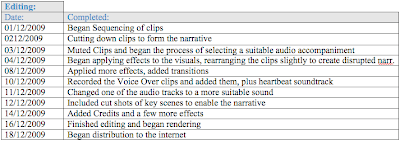
To do all the editing, we used a programme called imovie hd, it was very efficient as it is simple to use and the outcomes are extremely professional, it is also an ideal progrogramme to use when we come to upload the video to the internet.

http://en.kioskea.net/telecharger/telecharger-1238-imovie-hd

To add the sound effects we used garage band simply because it was simple to make and then extremely easy to place on the I movie file.

http://www.apple.com/ilife/garageband/

Finally we used a programme called audacity to edit the speech recordings, this was because we originally imported the clips onto the imovie file, the recordings were too quiet, however we could edit these recordings in audacity and then and then place them back in imovie at a higher volume.

http://audacity.sourceforge.net/


The following people had the following roles:

Matthew Popple: Director, assistant cameraman, Chief Editor, Male actor

Joe Scaife: Chief cameraman, assistant director, assistant editor

Claire Dring: Main character, Assistant director and editor.

Christian Place: Supporting actor

There were four locations for this film, the first of which was in a park called queens park, this was an ideal location as we were the only one there which added to the idea of the girl being alone in the world. The other locations were in a house, in a school and in a field, these were all efficient locations as it connotes the theme that the girls past is haunting her all over.

TASK 8

OBJECTIVE: The following proposal is for a short film which follows the memories of a girl clearly confused, distresses and curst by her past mistake. By using a variety of different camera techniques and effects, we plan to capture the girls emotion as she is pushed to the ‘edge’.

SETTING: The setting of the film is set in the present time, set in four different locations, the first being in a park, the second in a field, the third in a house and the final in a school. The variety of locations could connate how her emotions are following her wherever she goes.

TIME DURATION: apporx 3 mins

DESCRIPTION: The short film is about a teenage girl who is having a very stressful life. Bullied at school, and an alcoholic at home she is pushed further and further until emotionally she can’t take any more. It is upon the location of a field where her friend confronts her trying to find out why she is so distant and what is making her the way she is. Distancing herself away from the world the girl ignores her only friend and as words and actions are said and made, the girl is pushed to the point where she takes the life of her only friend due to anger, rage and hate. As the event becomes a thing of the past the girl finds herself alone in a park where she is haunted by the guilt of her crime, finding herself impossible to live with, the girl can no longer take any more, does she commit suicide? Does she run away? . . . No one knows.

REMARKS

There will be a dark contrast and a soft focus on the clips of the present, this will connote her guilt and state of mind, and how her crimes have darkened her future.

The clips of the past will be filmed in black and white obviously signifying the past tense; however there will also be a ghost trail to connote the fact that the events we see are all memories.

The film will only involve 3 or 4 talking parts, this will add to the effect of the enigmatic theme, it will allow the audience to think for themselves instead of being given all the answers on a plate.

PROPOSED SEQUENCE OF EVENTS


The first shot will be of a blank screen, upon this blank screen, the title of the production team will come on.

There will be an immediate flash, and from this flash in black and white there will be a picture of someone’s feet. This shot will then fade out to the next shot which is now in colour.
The next shot will be in a park and we will see the park gate closing, this will then fade into the next shot. As soon as this shot comes on, the musical bed will come on and play through most of the following shots.

The next shot will be of some park swings which are swinging by themselves. Because there is no one in the park besides the girl, this should add quite an enigmatic effect.

The previous shot will fade into this establishing shot of the park which as it pans and zooms at the same time, will introduce us to the main character of the teenage girl.

After the previous shot zooms into the girl, there will then be a flash which will present us with the next clip of the girl unscrewing a bottle of alcohol.

There will then be a flash to the girl now drinking the alcohol.

After this there will then be a shot of the girl falling in the bathroom, obviously drunk throwing up.

The next clip will be at school where we see the girl being bullied, the clip will also be presented by a flash and also in black and white as it is still an event of the past. At the end of this shot, the shot will fade into the next shot.
The next shot will be of the girl back in the present and in colour which is then quickly followed by another flash back into the past

The following 7 or so shots will all be in black and white, and these shots will develop the narrative and her friend whom she quickly falls out with as we then see him walk off and then fade back into the present.

The next scene now in colour, will have a close up of the girls eye where we can clearly see emotion, and as she blinks we will se the image of the body on the floor again.
The next shot will see the girl jump off of the climbing frame she is sat on and as she lands, we will flash to even more revealing of the body.

The shot will then pan around the girl both losing and gaining focus, and as it progress there will be a quick montage of her past events as shown previously. This process will repeat about 3 times.

After the process has been done, the shot will then flash and the music will cut. The screen will stay white for a while and as it fades back in, another song will be played.

The camera will pan around the park again, the swings still moving, however the girl is gone.

The final shot will then pan down to the ground where we see an item of the girls clothing, this will then fade out to the credits leaving an enigmatic open ending

TASK 9
Below are recordings of our groups storyboards with discussions about the content.

(IF VIDEOS DO NOT PLAY, THEY CAN ALSO BE FOUND ON CLAIRE DIRNG OR JOE SCAIFES BLOG)


TATASK 10
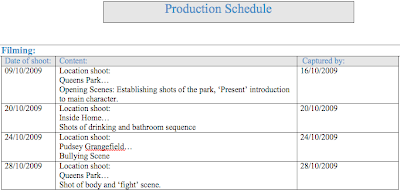


TATASK 11

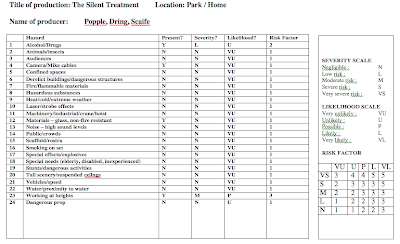
Risk assessment – “The Silent Treatment”

Health and safety risks –


Alcohol – we used an empty vodka bottle, however, we emptied the bottle of contents before filling with water. Therefore, there could have still been traces of alcohol in the bottle. 3

Climbing Trees – one shot in the film required Matty to climb up into a tree, this could have been dangerous as he may have fallen out of the tree and seriously injured himself. 2

Park equipment (Roundabouts, slides) – Matty almost fell off of the Roundabout while it was spinning; this could have caused an injury such as a concussion or broken bones. 3

Risk assessment

The grid categorises the severity and likelyhood of risks on a 1-5 basis.


TASK 12
Below is our actual single camera drama which we created.

(IF VIDEO DOES NOT PLAY, IT CAN ALSO BE FOUND ON CLAIRE DRING OR JOE SCAIFES BLOG)


TASK 13

EVALUATION UNIT 21

Purpose

Overall I feel that we achieved our purpose extremely well, we created a very successful single camera drama, which I felt worked very well, was extremely unique and very interesting.

Audience

We showed our single camera drama to a varied audience, the feedback we acquired was fairly varied again. Those who did like the production said this for some of the following reasons: They said that the video had an extremely effective musical be that when juxtaposed against the footage itself, work extremely well, particularly for the specific gene we were aiming at. The fact that throughout the whole production, we were continuously setting enigmas which kept the audience engaged to try and find out answers about the actual narrative and finally the fact that there was an open ending worked very well, as it makes the audience want more, and what to know what has actually happened to the main character.

Those who didn’t like the production had this attitude because of the following reason: The narrative seemed too complex and made no sense, so at the end of the drama they didn’t understand the relevance of the storyline or the message conveyed.

Representation issues

We didn’t particularly give any positive messages due to the fact it was aimed more within the genre of a tragedy, so instead many of the messages conveyed were rather negative and in many ways we may have followed the stereotyping of teens being abusive and binge drinking. Our video did feature a mixed gender, with both males and females within it, however we didn’t use a varied ethnic groups, instead we used the same ethnic group of white British. The music track I felt was very effective as it suited the pace and narrative and boosted the misenscene, and the location was very efficient as by doing it this fairly quiet location, it reflected the emotions and attitude of the girl. There was very little language used within the piece and as a result we didn’t have to worry about whether it suited the audience. I think that the video looked highly realistic for this genre, it was dark and hazy, which suited the confusion and distress within the girls state of mind.

Technical issues

The voice and music levels were set very well, and as a result, we could hear the dialogue perfectly over the music bed, as well as this I think that the music started stopped and faded at the most adequate times. The camera work was very efficient, I feel that the reason for this was because we shot the same scene a number of times, and as a result of this we had a variety of different shots to choose from so we could be satisfied with the best. I feel that there was a lot of variety within this production, for example there were flashbacks, repetition and slow motion, and this variety I fell kept the audience anchored. To record all the dialogue we used a sound recorder, and much like the use of the camera shots, we recorded the same piece several times so that once again we could select the very best clips. I did the majority of the editing for this single camera drama, and overall I think that it works very well, I’ve used a range of different transitions and video effects to try and keep the drama as interesting and as enigmatic as possible. There was only use of titles at the end which I feel suited the film very well, I also think that the effect of the titles shaking worked well as it added to the idea of mystery and enigma.

Narrative

I feel that the typical genre within this single camera drama was that of tragedy, primarily due to the fact where this girl is going through so much pain and hurt. More professional and successful versions of a production like mine I feel may have an advantage over me because of the fact they will have a larger cast, and more time and money to spend through the process of filming and editing. In our production we used narrative which included the idea of the enigma as well as that of the hero, villain and damsel in distress, with the girl seen as the damsel in distress and the boy as a bit of a villain. This particular piece was a single strand narrative, which focused on the thoughts and emotions of the female character.

Own performance

When looking at my own performance I think I worked very well, I saw myself as the team leader, organised everything and even did all the editing. Because of the sheer amount of editing I did, I feel that my skills and abilities within this area developed a lot, and the fact that I spent all my time out of lessons working on editing this piece was a huge strength overall within my performance. In terms of weaknesses I was fairly confrontational at some points when I disagreed with the other group members, particularly in terms of attitudes, however I did try and take onboard some of the opinions from the other members.

If I was to do this piece again I would probably try and join another group, because due to the amount I disapproved of the responsibility of the other two members, I found that some of the work could have been a much higher quality.


Unit 22: Multi-Camera Techniques


TASK 1


The multi camera technique, is a form of filming television programmes or films, where on the same scene or set, there are more than one cameras in operation film the same ordifferent parts of the scene. There are a veriety of different programmes which opt for this form of filming rather than the single camera technique. For example, talk shows such as The jeremy Kyle Show or Friday night with Jonathan Ross uses the multi camera technique. Within these shows, not only do they producers have cameras directed at the guests and hosts, but they also have cameras pointed at the audience. This allows the audience recactions to be shown in there true forms, increasing the sense of realism and make the viewers feel as if they're part of the set. Other programes which use the multi camera technique are those which are filmed live , this includes sporting events such as football games or even live music. The primary reason for using this technique in these events is due to the fact that if the audience watche the whole event from one shot, then they would lose interest. So the multi camera technique keeps the audience anchored. Another good thing about this technique is the fact that each camera can be at a different angle, for example one could be a long shot to convey the overall scene, where as another could be an extreme close up to cature facial expressions.


Info: Wikipedia

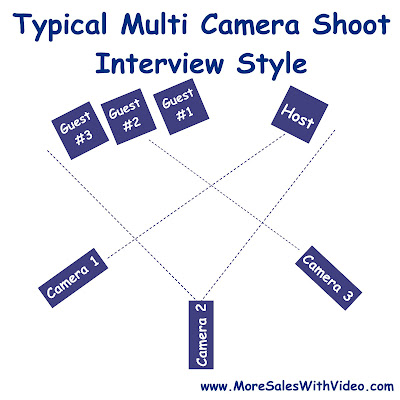
Below is a typical set out for a multi camerad talk show:


As we can see, camera is specifically being used to film the host, whereas camera 3 is specifically being used to film the guest. Theis means that the person incharge of selecting the shots to be shown, can continuosly swithch between the two cameras to so the audience can see what both the hosts and guests are doing. Camera 2 however is a longshot, and is filming both the host and guests, this will allow the viewers at home to feel as part of the audience and will vary the effect of the programe to avoid continuosly switching between the same two shots. It would also be typical to see a 4th camera if the programme was fimed infront of a live audince to gain their reactions as well. The shots here would range from filming the whole audience from a long shot to an individual person with a close up.


TASK 2

In the clip of Lamar singing, there are a veriety of different shots used all to good effect, for example the opening shot immediately fades to an extreme facial close up, shots such as this one may be very popular with som audiences, as the singer will keep fans anchored into the show, and in mny cases they re a star vehichle, increasing the popularity of the programme just because of their apperance. Over shots used include the typical long shots and panning shots, by using these, the audience gets a wider picture of the actual scen, and considering the uses and gratification theory, will create diversion from there current lives and make them feel part of the audience seeing what you would expect the actual live audience to see. The transitions within this clip consist of the single effect of fading too and from each of the different shot, and when considering the spped of the transitions aswell as the peed of the camera movement, these are all used for the exact same reason, to suit the pace of the song. The song is veryslow paced, thereofre using abrupt fading, or even direct cuts to and from each shots aswell as speedy camera movement or zooming, then it wouldn't suit the pace of the song whatsoever. Therefore by using these simple but effective slow paced camera movements and trnsitions, the miseenscen can be established extremely well.

In the blue peter Grease scene, the shot we are firstly presented with is postioned directly at the presenter, by having this mid shot directly looking at him, it adds to the diversion and surveillance effect within the uses and gratification theory, as if he is actually having a conversation with us as the viewer and informing us about tthe scene coming up. When the scene begins, there is a panning down shot of the the wole set, this allows the audience to see the whole picture and feel which is trying to be created, there are then two cameras which long hots are positioned between the group of men and the group of woman. By doing this a signifier is created to convey the fact that the location of these two groups are infact in different places rather than on the same stage creating this sense of effective anti-realism. Aother effective shot which are used when filming both groups, is the shot which beginsed focused with the close up of the two main charectars, and the zooms out to film the rest of the group. By doing this, audience can establish the main charectars, and possibly the scenes hero and damsil and distress, before being introduced to the supporting cast. Unlike the previous clip of Lamar, the camera movemnts and transitions are much more abrupt, to begin with however they are fairly slow, to suite the pace of the song and justifying the secen, however as soon as the musical bet and singing speeds up, so does that of the transitions and effect, and by doing this the scenes tempo is increased, and due to the ever changing montage like effect of clips, ythe audience is continuosly anchored in.


Task 2 cont. . .

In the formula one clip, the main meaning is to basically inform viewers of the sport. This is done to great effect using the voice over. The deep voice as well as the music bed used within the opening introduction conveys it's meaning by having a fairy serious mode of address. The fact that all of the opening shots a in black and white, and dark, creates a rather film noir effect. However although this formal and serious mode of address is created, the shots used which insome cases seem to serven no purose to the actual meaning, create a sense of anti realism, distracting viewers, grabbing their attention and keeping them anchore into the programme. The programme is obviously aimed at those who enjoy the sport, and have a keen interst in cars, this is the main justification behind the content of which the narrative speaks. However the short clip of Lewis hamilton is used within the introuction, as the will be an immediate signifier of the sport meaning if anyone saw this clip familiar with the atlete, then they would instantly know the purpose of this clip. However lewis hamilton will also be used as a star vehicle, having a hudge fan base, and by seeing this clip, views are more likely to keep watching than if there would have been no shot of him whatsoever. Finally many of the opening shots are close ups, and as a result, the audience is given a strong desire to keep wathin as not much is being given away up until the poin where the music, and transition speed increases due to the sudden change in pace with the much quicker music bed juxtaposed against the shots.

In the match of the day clip, the main purpose is to inform viewers of the results of the football. Obviously the primary target audience here will be football fans all over the world. To inform viewrsin many ways through the surveillance factor when considering the uses and gratification theory, there are the tables featuring the results, juxtaposed the premiere league trophey, signifying the fact that these results are obviously for that specific trophey. There is the voice juxtaposed againt the results which i fel is a very good way of acheiving its purpose, as the viewes will no longer be distracted by anyone one on the programe, instead they can look and listen directly at the scores and remained acnhored, also in a sense of diversion away from eveything else. The main part of this clip comes when there is the montage of the different games which have taken place within the seaon, this montage is created using the original clips and commentary from the games, then combined, this is juxtaposed against the action like musical bed. By doing this, a serious amount of tention is created keeping a veriety of primary, secondary and niche audiences anchored to the programme, there are purposely quick transitions within this clip, and by doing so the sheer pace of the shots and the atmosphere created matches that of the tension created by the musical bed. The panning round of the trophy at the start of this montage is obviously nother signifyer which connotes the relevance of the up coming clip, and the faded in shots of the four managers around this trophey is a signifyer that these were the four main contenders for this prize.


TASK 3

Below is the mind map of all the initial ideas which our group has come up with when considering the different content to place within our own multi camera programme.


TASK 4

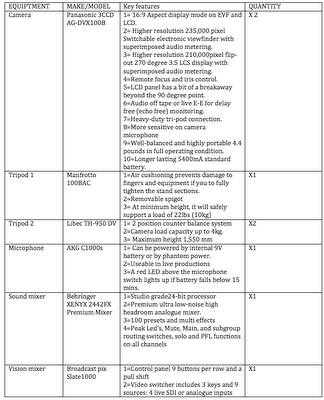
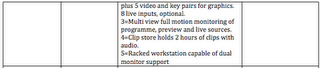
Bleow is a list of all the different peices of equiptment we will ee using within this programme, some of the key features and how many peicies of each individal modal we will be using.


TASK 5

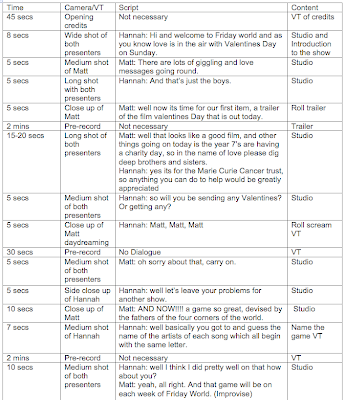
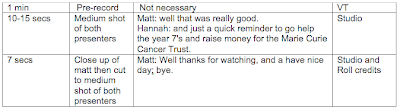
Below is the shooting script for our multi camera programme, within it is estemated time for each shot or clip, what the cameras will be doing, what the two hosts will be doing and what the content will be.


TASK 6

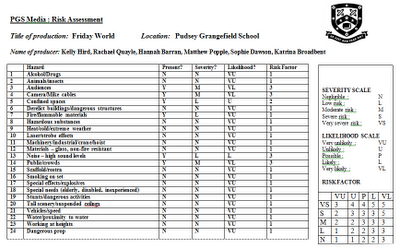
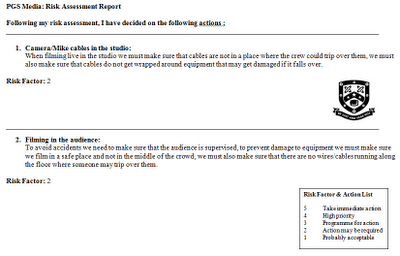
below is the risk assesment for the actual multi camera drama it'self


TASK 7

MULTI CAMERA DRAMA


TASK 8

Unit 22 evaluation

The purpose I feel was achieved within this production, as we hosted a live multi camera television programme, which was the main goal of this unit.

Audience

We showed our multi camera programme in front of a live audience, there were some fairly negative comments for the following reasons: The camera shots didn’t work extremely well, and the order in which they cut to each other were fairly unsuccessful because sometimes they focused on the wrong person when the other host was talking, then when the content of the actual programme was played, it cut back to the hosts too early so that not all of the clip was actually played.

Representation issues

There was a fairly positive message shown within this programme, particularly in the idea that this was a television programme created by the actual students of the school, however the issue we did have was that although there was a mixed gender within the program, there wasn’t much ethnic variation in terms of the hosting however in some of the contents of the clips, there was some ethnic variation. The opening music bed suited the show as it holds great relevance to the programme and it’s identity, however because the show was much like a news programme, there was no need for a musical bed when the hosts were talking. Obviously the location was suitable as it was filmed in a studio, which could then be broadcast live. The language was fairly suitable for the target audience, primarily because of the fact that the two hosts were both at the same age group as the primary audience, and as a result, by talking as they would usually, the hosts would be able to relate to the audience.

Technical issues

There were was a number of technical issues within this program, the main issue cam from the actual broadcasting room where the group members had to chose which shots to be shown live, and because of several mix ups, several wrong shots were selected at inappropriate times. The microphone levels could have been better, as there was only one microphone between two hosts, therefore every now and again the hosts would not be heard very clearly, plus every now and again the voices were cut off before they should have been, this seriously reduced the quality of our piece. There was a lot of variety however within the show, which came from the varied content, which made up the live show, this included the game show “the name game” which increased the idea of viewer interactivity. We didn’t use any titles in this production, and In terms of the editing, because every thing was being shown live, the main form of editing came through the form of timing, and as already mentioned, this timings could have been much better.

Narratives

I feel that more professional programmes like the idea of the television show have serious advantage over us, and although the equipment we have is fairly sufficient, we didn’t have the most time and preparation to remove all possible issues, as well as this I think that professional live shows will have more effective communication between the cameramen and the vision mixers. In terms of narrative we only really had and equilibrium with the start of the show and then the resolution with the ending, not much of a disruption was present.

Own performance

Didn’t really learn any new skills within this production, the reason for this was because I was a host rather than using the equipment, so really if anything, the only skill I did develop was my hosting skills. As strength I saw myself as a strong team member who gave very efficient contributions in terms of the pre production stages. As a weakness however, I feel that perhaps I may have spoke too much rather than let the other host have some dialogue time, despite the fact we were sticking to a script. I didn’t argue in this group and as I result I feel we worked responsibly and effectively.

If I was to do this unit again, then when we actually made the production I think that I would have rather used a piece of equipment rather than host, as I see it as a much more interesting and challenging contribution to the group.